
Originally Published December 23rd 2020.
Every transfer window a raft of stars emerge from the Championship and gain significant moves to arguably the greatest league of club football, the Premier League. With BREXIT pending along with an array of new registration restrictions on playing personnel, Premier League teams will have to look increasingly inwards for talent identification. However, the thought of securing players from the Championship should not be seen as a downgrade compared to overseas pastures as the division below constantly provides the Premier League with a multitude of quality professionals.
In recent seasons, major movements have come through the Championship from a magnitude of clubs looking to sell on their prized possessions at a profit. Take Brentford’s experience at not being averse to selling valuable assets to top division clubs as shown by Ollie Watkins’ £28 million move to Aston Villa after signing him from Exeter City for £1.8 million three summer’s previous. Said Benrahma’s loan transfer (with a permanent option) to West Ham, Neal Maupay’s £20 million relocation to Brighton, Ezri Konsa’s £12 million move to Aston Villa and the £12 million departure of Chris Mepham to Bournemouth are all further evidence to a ‘talent factory’ operating from one of the Championship’s most modern inclined clubs in Brentford. It wouldn’t be wise to take Brentford as an anomaly either, Bristol City brought in over £40 million via the sales of Adam Webster, Lloyd Kelly and Josh Brownhill in the summer of 2019. This exodus of talent to bigger stages continued this summer highlighted by Jude Bellingham’s £20 million move to Bundesliga behemoth Borussia Dortmund, Eberechi Eze’s £16 million cross-London transfer and Matty Cash’s £14 million Midlands move. According to Transfermarkt, in excess of £312 million was spent on Championship players in the summer of 2020 despite a COVID-19 impacted window. In perspective French Ligue 1, historically viewed as a Top 5 League where leading talents should ply their trade, received only £31 million more from departures in the same window, arguably one top players’s value like Gabriel Magalhaes’ transfer to Arsenal.
Whilst the Championship may be viewed as the most straightforward platform for a player to earn their stripes before they are seen as worthy of gaining serious minutes in England’s principal division, there is a strong case the actual ingredients of the Championship namely competitiveness and toughness has moulded some of England’s preeminent players into the professionals they are today. 64.7% of the 34 players to represent England’s national team in 2020 have played within the Championship revealing the role the league holds in developing the nation’s finest talents. Besides the number of quality loanees currently cultivating their skillset in the hope they make it at the top level, there are a plethora of Championship owned players who are deserving of making a name at the holy grail of English football. Jake Cooper, Josh Dasilva and Adam Armstrong are all players meriting of a major transfer into the Premier League.
Jake Cooper-Millwall-Centre Back-25 Years Old
Over the last few seasons, ball-playing centre backs have come into the ascendancy within multiple levels of English football due to the rise of coaches urging players to ‘play from the back’ resulting in a greater demand for defenders who facilitate such passing dynamics rather than hinder them. However, there is still a need for the more traditional centre-backs who specialise in the defensive arts rather than the expansive passing that has become so prominent in recent times, after all the majority of defender’s primary objectives are central to defensive actions. Specialising in arguably both is Millwall’s giant Jake Cooper who stands at an imperious 6’4″. Whilst Millwall still maintain a disastrous reputation off the field, on the pitch the team under the leadership of Neil Harris and now Gary Rowett have developed a solid side from which Cooper is the fulcrum of the defensive unit. Over the last four seasons since departing from fellow Championship team Reading, Cooper has steadily become one of the league’s elite centre-backs despite not being close to the typical peak age of a centre-half.
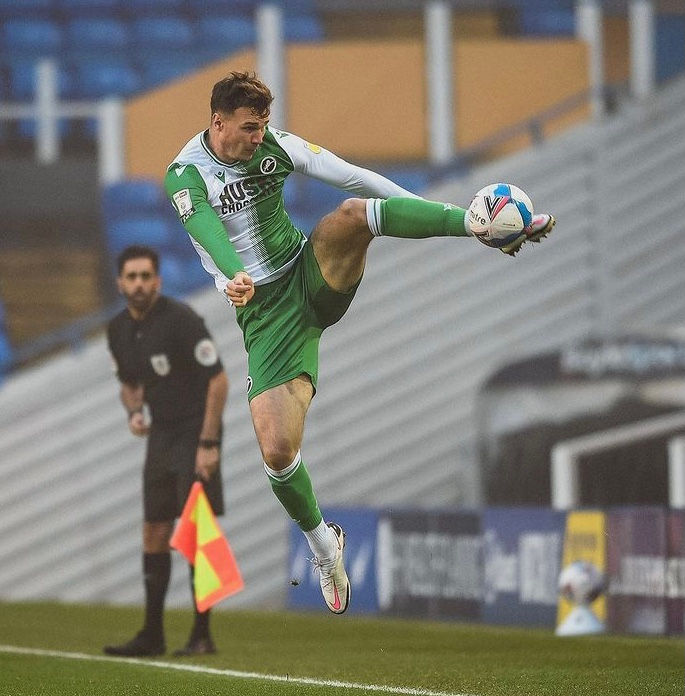
Utilised in a substantial low-block system where pressing is essentially non-existent which is emphasised by Millwall allowing a staggering 14.84 PPDA, the second highest number of passes allowed per defensive action in the Championship, there is great weight placed on the defensive unit as they defend so close to their own goal. Despite the considerable pressure Cooper is frequently tasked with, he is suitably adept at metaphorically ‘putting out fires’ in a manner of forms.
As you would come to expect from a defender with such height, Cooper excels aerially with a win rate of 70.2% in his 168 aerial duels, ranking him 11th out of all Championship players in the % success category so far in the 2020-2021 season. Making use of his frame he is able to manoeuvre himself against opposition in order to dismiss a high proportion of crosses into the box, in doing so his tally of clearances is often high. Whilst this is mostly useful in his own box, Cooper has had plenty of joy in the opposition box in set-piece situations which is highlighted by 13 goals and 7 assists in his four Championship seasons at Millwall.
For a defender a giant frame typically translates to a reduced level of agility and acceleration, however Cooper is far from sluggish. He possesses functional acceleration which is used to sweep out the majority of dangers. His total of 13.3 ball recoveries per 90 minutes in the 2020-2021 season suggests he has the mobility to patrol the defensive third effectively. His blend of mobility and size make him the perfect candidate in a defence that has to withstand continual bombardment when sitting deep while also equipped to compete in individual duels. His defensive duel success (excluding aerials) stands at 71.3% of his 136 duels revealing his steely nature. A sign of his refined maturity beyond his years is that he has only attempted 3 sliding tackles across 19 league games showing.a high standard of composure which is further accentuated by only receiving 1 yellow card in the same period.
In possession Cooper performs well too. Critically he is left-footed which is becoming an increasingly sought-after trait as it enables the possibility of more passing lanes to be constructed compared to a right-footed duo at the centre of defence. From his deployment within the left side of defence, he is rarely satisfied with simple passes. Cooper often attempts floaty balls which pierce the opposition’s defensive line but give his teammates ample opportunity to latch onto. Despite his size he has the awareness and technical ability to beat a player and launch a promising forward ball as shown here against Bristol City.
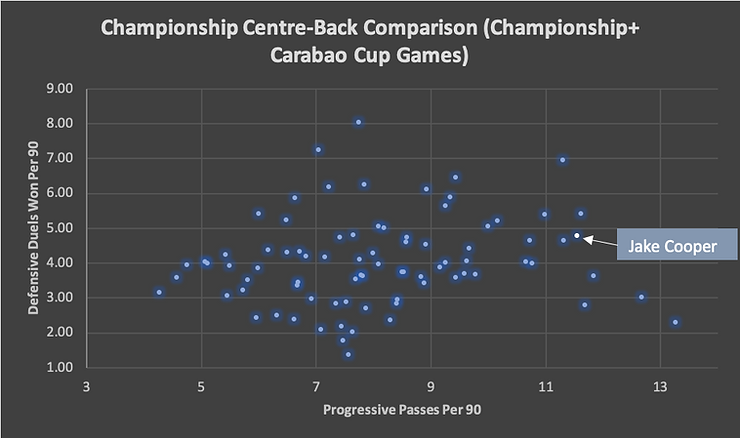
Swivelling to give himself more passing opportunities combined with a calm demeanour have led to his passing games becoming a key point of his game regardless of the system he operates within. 241 progressive passes so far within the league places him 5th of all players this campaign implying his willingness and commitment to moving the ball further upfield which is unheralded given his strong defensive acumen. As shown by Graph 1 below, Cooper is comparatively strong in progressive pass frequency and defensive duel success when correlated with other Championship centre-halves.
Graph 1-Scatter Graph Comparing Championship Centre-Back’s Defensive Duels Won Per 90 and Progressive Passes Per 90
One area Cooper could improve on is his anticipation and ability to make interceptions. Acting in a conservative rigid system where players are advised against making aggressive decisions, Cooper is restricted in stepping out and eliminating threats as he is almost always on the back foot. Potentially in a different system he could come undone when he is forced to decide whether to step out or not as he hasn’t had a great experience of doing so in the past.
Cooper’s combination of sheer physicality, individual duel success, threat in both boxes and ability to progress the ball reveal a complete centre-back regardless of the system he currently plays in. Despite being a few years away from the common peak of a centre-half, he is already capable of playing at a higher level and still has time to improve on his game. A Premier League move within the next two windows should be on the cards given his skillset. Suggestions of a move to either Burnley given speculation of James Tarkowski’s future or Crystal Palace considering their ageing backline and locality to Millwall would be rather sensible moves for the colossus that is Cooper.
Josh Dasilva-Brentford-Centre Midfield-22 Years Old
After managing only 59 professional first-team minutes, all within the Carabao Cup, Josh Dasilva decided to seek pastures new by ending his 12-year association with boyhood club Arsenal. Unlike fellow Hale End graduates Joe Willock, Eddie Nketiah and Reiss Nelson, Dasilva felt a new pathway for consistent senior minutes was elsewhere, potentially a decision Arsenal regret not interfering with given their current midfield predicament. Brentford a club increasingly becoming notorious in their creative recruitment process gambled on the box-to-box midfielder despite questions regarding his attacking output across multiple youth team age groups.
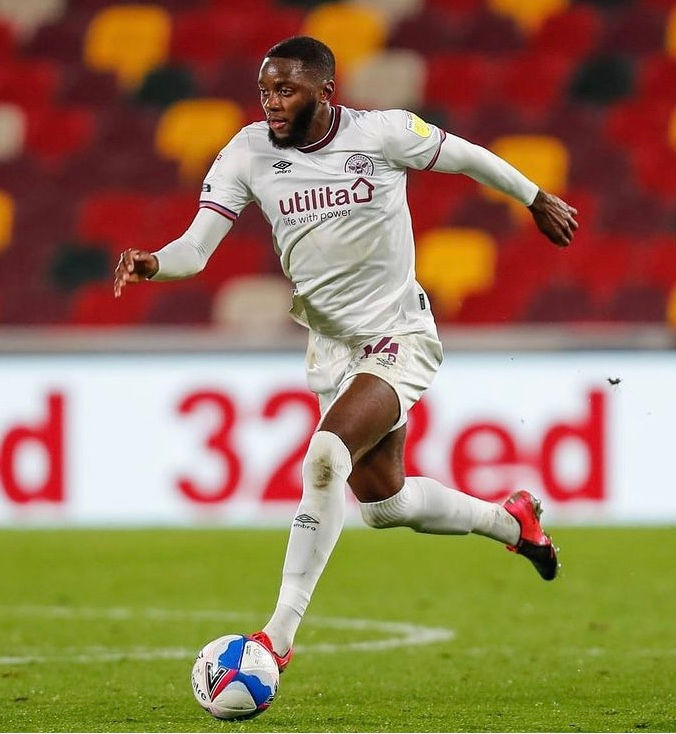
Under Thomas Frank’s tutelage, Dasilva’s trajectory over the past two and a half seasons has soared in a similar fashion to Brentford’s own fortunes. Featuring in over 3,100 minutes within the 2019-2020 league season, Dasilva became a pivotal part in the free-flowing Brentford alongside new Premier League recruits Watkins and Benrahma. Gifted license to be an attacking piece of the midfield, Dasilva utilised his multi-dimensional skillset to full effect signified by 10 goals and 4 assists. Whilst the departures of Watkins and Benrahma have had a slight impact on Brentford’s creative synergies this campaign, Bryan Mbuemo and new signing Ivan Toney are benefitting greatly from Dasilva’s presence. A sign of his career progression is the five England U21 caps he has earned in 2020 as well as capping a fine calendar year with a fine recent man of the match performance against Newcastle United in the Carabao Cup signalling his expertise.
Dasilva’s main skill is his immense ability on the ball. Similar to the likes of Ruben Loftus-Cheek, Dasilva moves the ball with ease in transition with both power and guile. Amalgamating great ball control, a muscular frame and ability to escape encloses spaces, Dasilva is highly qualified in possession which subsequently creates spaces for Brentford’s attacking cohort to invade. A symbol of Dasilva’s proficiency is his 3.92 progressive runs per 90 minutes, a figure which ranks him 4th across all Championship players. Dasilva is not immune to attempting a take-on against the opposition either, his attempted dribbles stand at 112, joint 5th in the league. Critically his dribbling success rate of those 112 attempts is a staggering 66.07%, 7th highest in the league in that bracket, which is almost unprecedented given the sheer volume of attempts. Here it easily identifiable Dasilva has a penchant of ball-carrying success.
In terms of passing competence Dasilva is fairly capable. His aforementioned ball-control alongside a strong technique enables him to operate a wide of arsenal of passes. Frank’s system where width is prioritised, Brentford games have a tendency to become stretched within the second half in particular. When exploiting the space in transition, Dasilva uses his combination of passing range and ball-carrying exceptionalism to hit the opposition at speed facilitating the likes of Benrahma, Watkins, Mbuemo and Toney over the last 18 months.
In relation to ball-striking Dasilva is as clean as they come. His Hale End education learning from the likes of Thierry Henry, once a coach within Arsenal’s youth team set up, has come into fruition in West London. Whilst he has not been as effective this campaign compared to last he has continued to over-perform his Expected Goals revealing a greater quality than ‘normal’ when taking shots.
Table 1-Josh Dasilva Expected Goal Comparison for Brentford in all competitions between 2018-2019 to 2020-2021
| Season | Games | Goals | Expected Goals (XG) |
| 2020-2021 | 24 | 4 | 2.37 |
| 2019-2020 | 46 | 10 | 5.01 |
| 2018-2019 | 21 | 1 | 0.35 |
Dasilva is lethal on his left-foot as shown by this strike against Nottingham Forest but is also adequate on his right-foot when the situation requires the ball to roll onto his less-favoured side, like this goal against Huddersfield Town.
Defensively, Dasilva has scope to improve despite largely being the vanquisher in his defensive duels, 65.4% success rate out of his defensive duels in the 2020-2021 Championship season. Dasilva primarily channels his energy into the transitional and attacking phases of the game meaning his defensive output is rather subdued. 2.7 interceptions per 90 and 4.3 recoveries per 90 are distinctly below par in comparison to his midfield counterparts at Brentford. Mathias Jensen who operates alongside Dasilva in a midfield trio averages 3.7 interceptions per 90 and 4.8 recoveries per 90 showing a greater contribution to the defensive phase. If Dasilva could elevate his defensive work-rate and positional awareness more in-line with Jensen’s, it would substantially improve Dasilva’s value to the team in becoming a true box-to-box midfielder.
Josh Dasilva’s ability is abundantly clear to anyone who studies his game. His ball-carrying orchestration is masterful and the Premier League is no doubt his next stage in either Brentford colours or at an alternative club. Time will tell if Thomas Frank’s team are Premier League material but Dasilva’s future should be at the next-level despite his new four-year contract with the Bees. A sign of Dasilva’s ability is that he would fit likely fit in well even at a club like Everton’s calibre as slotting in alongside the more defensive-minded Allan would provide Dasilva the defensive cover he currently requires. Other rational destinations would include Brighton’s next to Yves Bissouma in the midfield pivot Graham Potter utilises or even at West Ham where extra dynamism is required alongside Tomas Soucek and Declan Rice.
Adam Armstrong-Blackburn Rovers-Centre Forward-23 Years Old
Similarly to Josh Dasilva and so many others who drop down a level from the Premier League, Adam Armstrong has benefitted strongly from a settled role and consistent game time within the Championship. There was once great hope at his home city Newcastle United that he could follow in the footsteps of local striking idols Peter Beardsley and Alan Shearer however it never panned out. After a hugely successful loan spell in 2015-2016 where he lit up League One in Coventry City colours by scoring 20 goals in 40 league games superseded by playing a part England’s FIFA U-20 2017 World Cup triumph, Armstrong appeared destined for the Premiership in the famous black and white stripes of Newcastle. However, a disastrous half-year loan spell at a struggling Bolton Wanderers stunted Armstrong’s development significantly. Subsequently a drop down a division to League One at Blackburn Rovers was required to renew the striker’s confidence which led to him helping Rovers finish as runners-up and reclaim Championship status. A semi-surprising permanent moved ensued to Ewood Park and despite enduring a mediocre 2018-2019 season, Armstrong has since flourished under Tony Mowbray’s stewardship. 15 goals and counting in the Championship, placing him second in the goalscoring charts has Blackburn fans purring online of a potential playoff push, however they may not be able to keep their talisman for much longer.
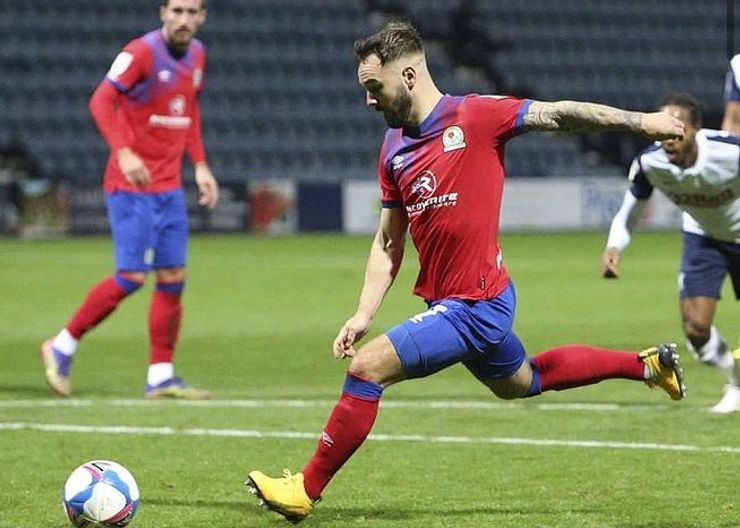
Armstrong’s profile is a pure goal scorer, he may not create many opportunities for teammates or be an aerial threat whatsoever but he is as active as they come in attacking phases. In a sole striking role Armstrong is the clear beneficiary of a talented supporting cast containing highly-rated Liverpool loanee Harvey Elliott on the right flank, ex-England under-19 star Ben Bereton and ex-Germany international Lewis Holtby. The thought of a fit again Bradley Dack joining this group is a frightening thought for Championship defenders.
Armstrong’s XG per 90 stands at 0.70 which is the highest of any Championship player with over 400 minutes this term, however this is due to his sensational frequency of shots. No player comes close to Armstrong’s volume of 4.64 shots per 90, Ivan Toney the player ahead of Armstrong in the goalscoring charts averages 2.35 per 90 for example. Here it is objectively clear that Armstrong needs to be more efficient in front of goal and improve his shot selection needs to improve if he wants to shine in the Premier League but you cannot overstate his goalscoring nature. Critical to his confidence and shooting regularity is his two-footedness and natural ability to be in the right place at the right time. Of his 15 goals, seven have been with his weaker left-foot, many of which include running into the box at speed with a first time finish revealing a great technical ability alongside strong body orientation. His shot technique is mostly of high-quality but it is clear needs to make better decisions when defences are tight.
Armstrong comes to the fore when he manipulates retreating defences attempting to get into some form of structure with his individual movement off the ball. Rovers score an above average percentage of their goals via counter-attacks as Armstrong’s speed and swift alterations make it tricky for defenders to track his movements. His runs on the break and for crosses do not lack dynamism or desire so combined with his knack for being in the right position at the right time the ball often falls kindly for him.
Armstrong is vehemently at his best when he is running onto the ball at pace, rather than receiving the ball with his back to goal as his frame is easily swallowed up larger defenders. Although his first touch lacks consistency, he does display good close control in small spaces and an ability to hold onto the ball is evidenced by an average of 5.26 touches per 90 in the opposition box. With ideal footwork, accelerative prowess and agility, Armstrong is also a competent dribbler supported by 50 successful dribbles in his 19 league games thus far but he could improve upon is 49.5% success rate given his skillset.
In possession it is apparent Armstrong is far from the finished product as an XA of 0.04 per 90 is a poor reflection of his overall ability. Again, reducing the number of shots he takes which have a low chance of scoring from and instead threading passes to teammates is appropriate but it is arguable he lacks the necessary vision to become a key creator.
Defensively, Armstrong plays a considerable role in a highly ranked pressing system. Rovers rank 5th out of 24th with 9.64 PPDA with Armstrong having spells of relentless pressing. One area the striker can improve in his aerial duels, 22.2% success rate in the league, but at 5’8″ it is difficult to beat defenders much taller than him. Timing his leaps and hang time via enhanced plyometric training could add important marginal gains to his on-pitch behaviours.
Overall, Armstrong has all the hallmarks to become a prolific poacher at the top level having previously proved himself both in the Championship and League One. Armstrong has similarities to Danny Ings in relation to pressures, touches in the box per 90 and shot activities but he does need to improve on his shot selection. An ideal landing spot would be Brighton as he is definitively more proficient than Aaron Connolly. Even a role at Leicester City under Jamie Vardy who excels in transition and decision-making would improve Armstrong’s weaknesses.
Thank you for reading,
George
All Statistics courtesy of WyScout.com unless stated. All Statistics up to date as of 23.12.2020.
 The Mezzala In Midfield
Leave a comment