
Originally Published 25th July.
Oxford United has been the gold-standard for developing centre-backs within the EFL over the last eight or so years. Largely under the stewardship of Michael Appleton and now Karl Robinson, two English managers with strong reputations, numerous centre-backs have gone on to bigger stages after shining at the Kassam Stadium.
Chey Dunkley started the trend as was signed from National League side Kidderminster Harriers in November 2014 to then League Two Oxford. Dunkley was instrumental in helping the U’s gain promotion into League One in 2015-16 before moving onto the more illustrious Wigan Athletic in July 2017. Curtis Nelson signed from League Two Plymouth Argyle ahead of the 2016-17 season and featured strongly for Oxford for three seasons in League One before moving to Championship side Cardiff City in July 2019. Rob Dickie earned a significant £1.8 million move to Q.P.R in September 2020 after impressing for Oxford across three seasons after joining from Reading. More recently, Rob Atkinson departed to Bristol City for £1.4 million in the summer of 2021 after only one season at Oxford after joining from National League Eastleigh.
Lastly, Luke McNally, arguably the best out of lot, is the latest to depart to grander stages. Yes even Burnley can be viewed as grand in this context! 22-year-old McNally recently moved to Vincent Kompany’s side, one of the world’s greatest centre-backs in the last decade, in a reported initial £1.6 million move and it will take some doing to replace McNally.
A clear pattern of Oxford signing young centre-backs, developing them for a few seasons, before selling them on to Championship sides has emerged. Importantly for the club they are now selling for seven figure deals rather than losing their premier players on free transfers as was the case with Dunkley and Nelson.
Whilst 26-year-old Scottish international Stuart Findlay has just joined Oxford United from Philadelphia Union, another depth piece is required who can in future become a starting centre-back for Oxford. Also, it is likely Elliott Moore (McNally’s CB partner in 21-22) will soon attract more Championship attention despite a recent contract extension, so ensuring a CB is ready to play first-team football at the club once he leaves is extra pertinent.
With all this in mind, we can establish how Luke McNally was utilised, understand his strengths and weaknesses and briefly assess Oxford’s current options before finding suitable replacements.
Luke McNally Profile
First it is prudent to examine McNally’s physical profile. McNally has the perfect tools to succeed in the modern game as a centre-back. Standing at 6’4″ he has a broad frame to engage frequently in duels and overcome the opposition with his sheer size. He has the pro-typical build as on inspection has a good level of muscle (not too lean and not overly stocky) that is translated into a high level of agility. McNally is quick across the ground due to his quick acceleration although this does peter out over larger distances but is comfortable with situations out wide or further upfield. McNally demonstrates strong balance and can defend up-right whilst maintaining speed of turn when defending 1vs1. He is particularly good at adjusting his stance or shifting his weight when necessary. Overall, he has the ideal frame one would look for in a modern centre-back so it will be an ambitious task to find a replacement.

Before we look at the data, let’s understand how McNally was utilised under Karl Robinson in the 2021-22 season. Oxford United mostly lined up in either a 4-1-4-1 or 4-3-3 formation and have been revered for playing expressive free-flowing attacking football since Robinson joined in 2018. One thing to expect with Oxford games is that there will be goals galore but this should not be a direct indictment on McNally but a result of the system adopted by the U’s. Oxford’s full-backs are known for constantly over-lapping leaving their CB’s exposed once the opposition is able to counter in transition. McNally largely featured as the RCB alongside the larger Elliott Moore who mainly played LCB. McNally was the main CB tasked with progression and was afforded the license by Robinson to carry the ball out of defence with surging runs or with a pass to teammates. McNally did this exceptionally throughout the season and there were numerous highlight reels of progressive carries as the young star is a true embodiment of a ball-playing centre-back. McNally often played many short passes connecting the play well and keeping the tempo quick. McNally was also capable of spraying diagonals to the left-back or left-winger to switch the focus of attack, although his accuracy was inconsistent.
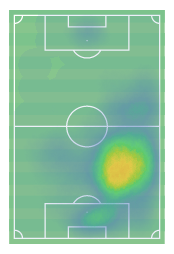
As shown by his heatmap to the left (via WyScout), McNally operates close to the half-way line and does the bulk of his work in the right-sided channel with his forward roaming inclination indicated .
Considering all this information and the system McNally operated in, it is vital to assess his data profile (below) to provide a more transparent and visual guide to his game.
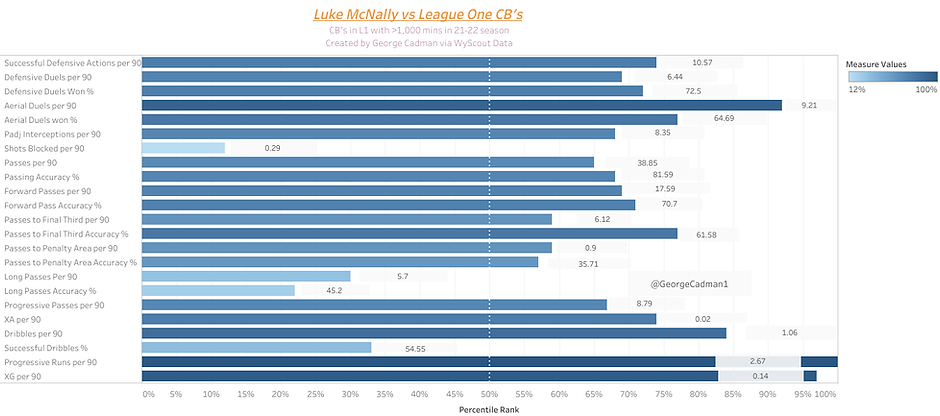
McNally’s date profile is extremely strong and fundamentally well-rounded. McNally figures as the perfect centre-back; strong in defensive duels, an outstanding progressive ball-carrier, secure in build-up, has a penchant for moving the ball forwards with passes and a tangible offensive weapon as well. At 22 it is so rare to see such an accomplished centre-back.
Critically, McNally’s defensive metrics are very good, sustaining a high rate of aerial and defensive duel success. In addition to this, his Padj Interceptions per 90 are very strong suggesting a strong level of agility, an ability to read the game and subsequently be able to position himself suitably. As evidenced by his duel metrics McNally is a very proactive and formed a good ‘dog+cat’ CB partnership with Moore. McNally being the energetic all-action ‘dog’ with Moore being the calculated and more stationary ‘cat’. See Michael Cox’s expert analysis on the dog+cat CB partnership theory here:
In possession, McNally is a very solid ball-player who enjoys venturing forward with the ball at feet. An overall passing accuracy of 81.59% is evident of a player who is tidy but often looks to thread the needle through the lines. All of his passing metrics (besides long-passing) indicate an above-average League One ball-player who should translate well to the Championship. Arguably, the most impressive statistic of McNally’s resume though is his 2.67 progressive runs per 90, a figure that led all League One CB’s in 21-22 with over 1,000 minutes. This is where McNally is at his best using his competent ball control, imposing size and quick acceleration to drive the ball into the right-sided channel which would suck in defenders.
Current Oxford United CB Depth
Identifying and securing an equally well-rounded replacement for a realistic fee will likely be a close to impossible task, but Oxford will have to try. What makes matters worse is that Oxford do not have appropriate CB depth even with new addition Findlay. Findlay mostly plays at LCB meaning Elliott Moore will have to slide across to RCB, which he is capable of doing as is right-footed. However, the club is very thin besides these two. Alongside the departure of McNally, loanee Jordan Thorniley has returned to Blackpool after featuring in 21 league games for the U’s. New-signing Ciaron Brown who will be the back-up LB to Steve Seddon is capable of playing as a LCB in a back three but is largely untested in a regular back four. Player/coach John Mousinho represents a very experienced option at 36 years-old but he only played 131 league minutes last season and is unlikely to feature at all. The only other current CB option is 17-year-old James Golding who is highly-rated by the coaching staff but is too youthful to depend upon for at least another season.
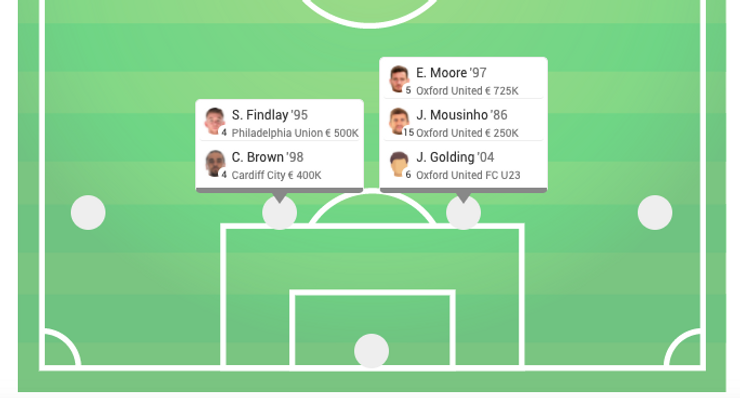
As the left-footed Findlay is joining the side as the main LCB and Moore can also play LCB if Findlay is unavailable, it would be wise to look for a RCB (like McNally was) to cover if Moore has to slide over or is unavailable himself, however recruiting a LCB is not out of the question. Furthermore, a permanent signing is the aim rather than a loan signing.
Ground Rules and Realistic Market Conditions
Despite Oxford making a large profit on numerous players over the years, the club like many in the EFL is tight for cash, not least helped by Oxford United not actually owning their stadium resulting in large annual rent payments to their hosts. Now whilst the club is attempting to secure a future elsewhere and move to a new stadium that they outright own, in the meantime the club cannot spend a lot on transfers. As well as this, there is the big elephant in the room that is Brexit meaning EFL clubs are limited to the nations they can recruit from. Due to these factors, it is sensible for this search to be conducted in the United Kingdom and Republic of Ireland. In addition to this, I am putting a cap on a reasonable transfer fee at £500,000 (I know this is subjective) bearing in mind McNally was sold for a minimum of £1,600,000, as the club almost certainly will put the bulk of that revenue towards this year’s rent of the Kassam.
The Longlist
With the majority of recruitment articles, a longlist is assembled with many profiles. For numerous reasons not all these players listed are perfect replacements for McNally but are noteworthy as have some qualifying characteristics. However, the purpose is to ultimately slim down the profiles until it is no longer a longlist but a shortlist with a few best-fit options.
Due to this, I set a handful of requirements I would base my search off, thus being:
-23 years old or under
-Playing in United Kingdom or Republic of Ireland
-TransferMarkt value of under £500,000 (many lesser-known players have N/A-so include these)
-Ball-Playing tendencies and ability to progress the ball frequently
-Strong Physical Profile who is competent in duels
-Potential for re-sale value
With all the above considered, below is a longlist of candidates who satisfy the aforementioned requirements and have a broadly similar profile to McNally.
| Name | Age | Nationality | Club in 2021-2022 | Positions Played | Contract Expiry Date |
| Kofi Balmer | 21 | Northern Irish | Larne | RCB, LCB | 2024 |
| Hayden Carter | 22 | English | Portsmouth (on loan from Blackburn Rovers) | RCB, RB | 2024 |
| Max Cleworth | 19 | Welsh | Wrexham | LCB, RCB | 2024 |
| Brandon Cooper | 22 | Welsh | Swindon Town (on loan from Swansea City) | RCB, LCB | 2023 |
| Charlie Fox | 23 | English | Queen’s Park | LCB,LB | 2023 |
| Joe Grayson | 23 | English | Barrow | LCB, LB | 2023 |
| Harvey O’Brien | 21 | Irish | University College Dublin (UCD) | RCB | 2022 (November) |
| Shadrach Ogie | 20 | Irish | Leyton Orient | LCB, LB | 2024 |
| Jack Sanders | 23 | English | Kilmarnock | RCB | 2023 |
| Eoin Toal | 23 | Northern Irish | Derry City | RCB, LCB | 2022 (November) |
With the longlist of ten players established above, a more specific look at just three players is required who provide a similar physical and technical profile to McNally albeit are less developed but nonetheless are appropriate replacements.
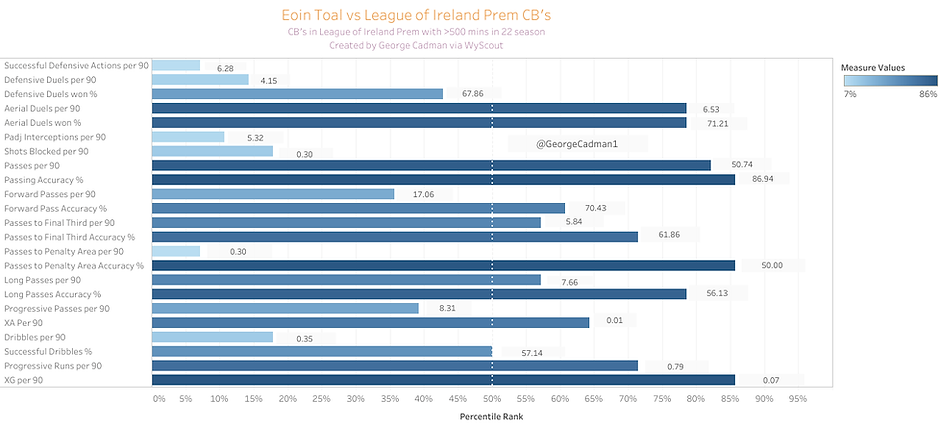
Note-Eoin Toal would have made my three-man shortlist ahead of Max Cleworth. I had actually started writing a detailed analysis (I had already made the graphic below) of Toal but reports started to emerge that a fee had been accepted from fellow League One side Bolton Wanderers which scuppered my plans. Bolton announced the move on 20th July for an undisclosed fee. .
Shortlist
Kofi Balmer-Northern Irish-Larne-Northern Ireland Premiership-21 Years Old-Contract Expires June 2024-Height 6’0″
Northern Ireland U21 international Balmer was a dominant force in Larne’s backline in the 2021-22 season as they qualified for the UEFA Conference League despite headlining Larne’s defence at the tender age of just 21 for the majority of it. Following a move from fellow Premiership side Ballymena on a free transfer; Balmer has taken like a duck to water with the step up faced in the league and it is apparent he has outgrown the confines of the Northern Irish Premiership.
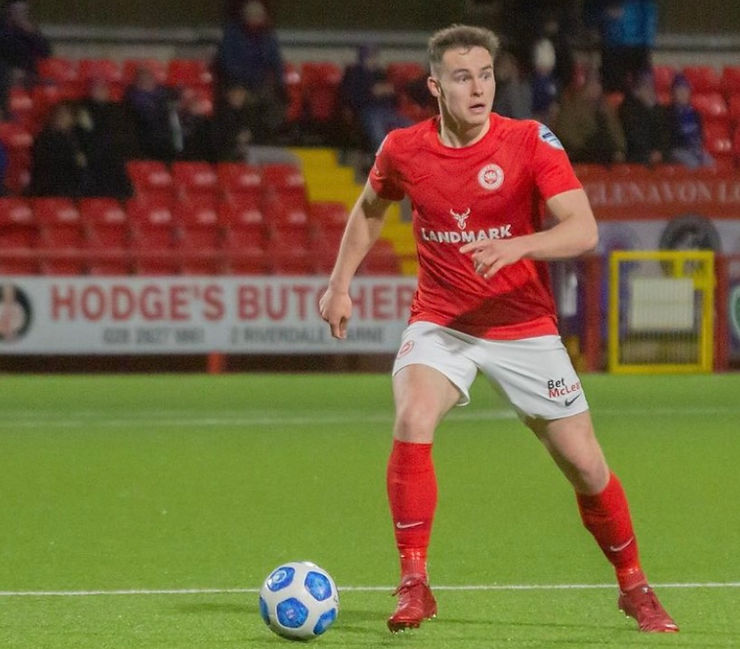
Below is Balmer’s data profile for league games in the 2021-22 season and it represents a strong well-rounded player who excels with the ball at feet. Playing in a possession-heavy Larne side, Balmer is the fulcrum of their build-up play. Patient on the ball and comfortable with both feet, Balmer is able to receive the ball in tight spaces before selecting a sensible and usually well-placed pass, although he can be guilty of trying too hard to play a wonder-pass that breaks the lines rather than opting for the simple open option at times. This attitude means Balmer progresses the ball forward at an impressive rate. Incisively cutting balls into midfield and long sweeping passes to the diagonal flank are indicative of Balmer’s desire to move the ball up the pitch at every opportunity which he does to great success. Beyond ball-playing, Balmer is progressive when carrying the ball too as often drives into channels with a surging run.
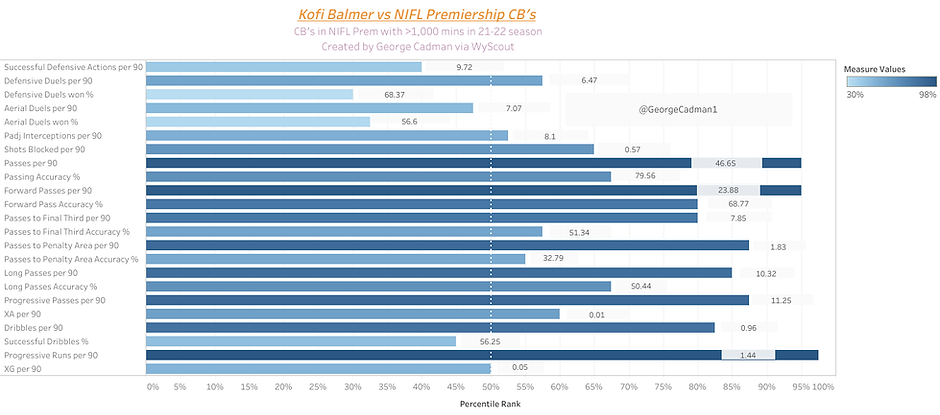
Defensively Balmer is a very solid option even if the bar chart suggests a weakness. The Northern Irish Premiership is stacked with physical centre-backs as well as the league containing many smaller forwards, resulting in a high amount of centre-backs who dominate duels. An overall defensive duel rate of 68.37% is not to be dismissed, McNally’s in comparison was 72.50%. Many centre-backs across the leagues would strive to achieve this level of duel rate success. 6’0″ is a rather modest height for centre-backs but Balmer does not get bullied in challenges easily and matches McNally’s build besides the four-inch differential. A key strength of Balmer’s game is his anticipation and front-footed approach alongside his strong agility which results in a good amount of interceptions and shots blocked; thus disrupting the opposition’s final third plans. However, Balmer is very susceptible to being rash in a challenge as shown by 12 yellows and a red card in the 2021-22 campaign, an area to work on for sure with the need for increased composure.
An undeniable caveat to the suggestion of Balmer is that the Northern Irish Premiership is a level below League One. However at just 21, Balmer has already shown enough quality and tangibles that can be translated to the division. As exhibited by McNally himself, albeit operating in the Republic of Ireland Premier Division, players can make the step up from across the Irish Channel. At around a likely fee of £300,000 Balmer would represent fantastic value for his skillset with a clear possibility of sell-on value for Oxford.
Max Cleworth-Welsh-Wrexham-National League-19 Years Old-Contract Expiring June 2024-Height 6’2″
Whilst Wrexham were regularly in the news for their star-new owners, sizeable wage budget and successful season that resulted in a second-place National League finish and Wembley FA trophy final appearance, an unsung local hero developed in the midst of it all. A regular at the heart of their defence was 19-year-old Max Cleworth who in his first senior season played a big part in their ultimately unsuccessful play-off push. After a half-year loan spell at Cymru Premier side Caernarfon Town in 2021, Cleworth impressed boss Phil Parkinson and has since played a central role at the heart of Wrexham’s defence alongside Ben Tozer. A sign of his performances was evidenced by winning the club’s Young Player of the Season.
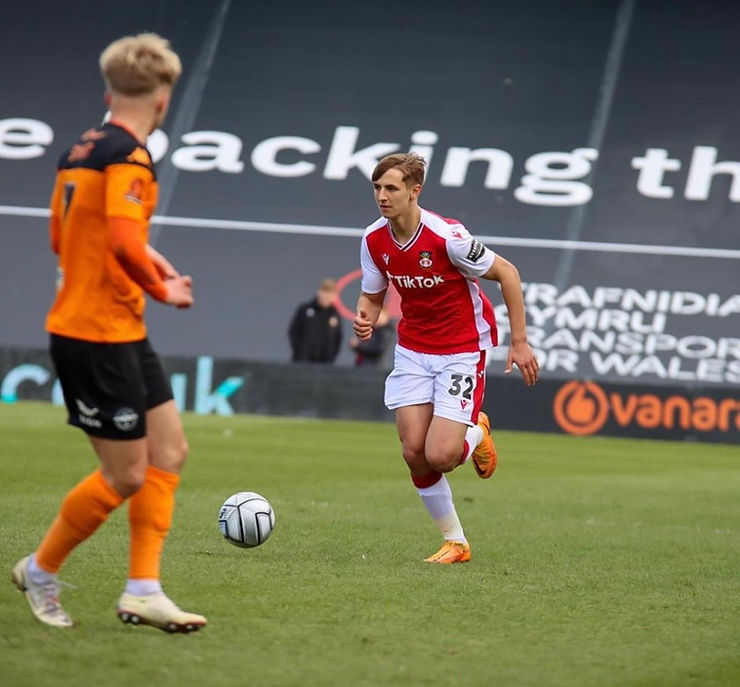
Capable of playing across the three centre-back positions, Cleworth mainly featured as either the left or middle CB in Wrexham’s attacking 3-5-2 formation. Comfortable on the ball with both feet, it would be hard to tell his favoured foot. Cleworth is a talented ball-player at his age and recycles the ball very well with a high accuracy of passes for the level he plays at. Cleworth can play progressively but tends to favour short passes to the wing-backs or midfielders on the second line. Perhaps he can be bolder with possession but it’s a good trait to be secure on the ball. Interestingly, Cleworth has the capability to step out in possession and make a central run with the ball past the halfway line as implied by his 1.70 progressive runs per 90. In the past Cleworth has featured in midfield positions and it’s apparent he has maintained the need to carry the ball from this into his more defensive role.
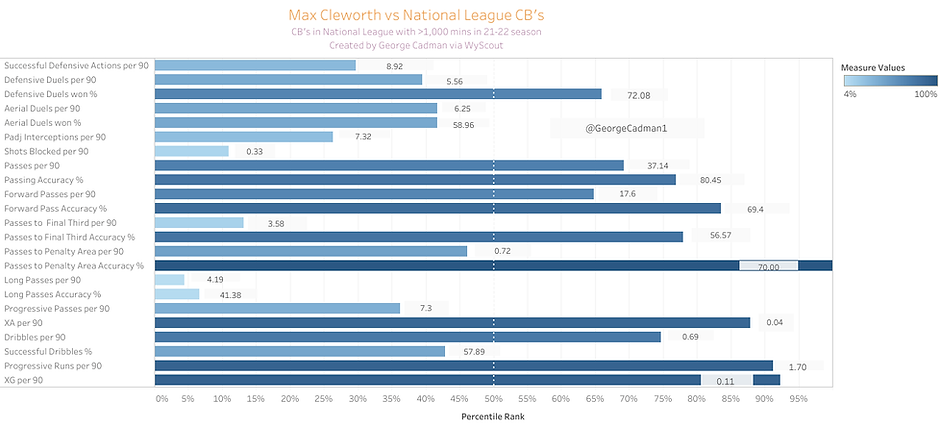
In physical duels, Cleworth has improvements to make but it must be reminded that he is only 19 years old and his frame of 6’2″ certainly allows for more bulk to be put on to his relatively slender build. Hopefully this summer he has focused on increasing his upper-body and core strength to become more robust in contact. An aerial duel success rate of 58.96% is rather average for a 6’2″ defender and at times was exploited by bigger forwards. Meanwhile his defensive duel success rate of 72.08% is evident of a very good tackling technique, functional body orientation and lateral speed. However, Cleworth does not get tight enough as prefers to let the attacker make the first move in a deliberate manner especially when dragged out wide. Unfortunately, this was painfully taken advantage of by Grimsby Town’s John McAtee in Wrexham’s 5-4 play-off loss where Cleworth allowed the dangerous McAtee to advance uncontested towards the edge of the box and subsequently provided an assist for one of Grimsby’s goals.
There are undoubtedly raw areas of Cleworth’s game but his possessional play, calm demeanour, good height and agility and desire to carry the ball have all the hallmarks of a talented centre-back. Now Wrexham will be unlikely to entertain many offers for Cleworth as he’s homegrown, only 19 and played a big part in their 2nd placed finish last season. However, they have added centre-back Jordan Tunnicliffe from Crawley Town so less minutes might be available this time around as Wrexham may favour more experienced players as they attempt to gain promotion again. Therefore, a permanent move elsewhere to a team like Oxford, but a return to Wrexham on loan for the season (with a recall option), might be a good move for Cleworth especially as the loan back will give a club like Oxford more bargaining power as they will likely have to pay less in a transfer fee as a result.
Jack Sanders-English-Kilmarnock-Scottish Premiership-23 Years Old-Contract Expires 2023- Height 6’3″
Perhaps a little left-field selection within this shortlist is Kilmarnock’s Jack Sanders who only featured in 14 league games totalling 890 minutes. However, he impressed in his limited time during Killie’s successful Championship campaign that saw them achieve promotion back to the Premiership. After failing to breakthrough into the Wigan first team following multiple loan moves out to Blyth Spartans, Southport and Fylde, a move to Kilmarnock was an unusual step out of his comfort zone. Assuming the fourth-choice centre-back role in a team that primarily plays a back four, (although did switch at times to a back three) meant Sanders had to take a backseat for most of the campaign behind more senior options. However, across the 14 league games he played in, Sanders was an undeniable unsung hero proving to be a terrific addition to the Kilmarnock’s depth chart in the process. Statistically, based on his first season in Kilmarnock he is certainly worthy of a starting spot if opportunities arise elsewhere.
Sanders fits the blueprint for modern CB’s likewise to McNally. Sanders’ physical stature and technical ability permits a two-way defender who can dominate in defensive duels and also add value in possession. Sanders’ size is striking and has an overall mature athletic profile containing a well-built 6’3″ frame akin to a rugby player with rounded shoulders and thick legs. There are concerns over his acceleration as can give up separation over a few yards to agile players as is a bit docile to quick movements, but demonstrates good enough sprint speed and agility over longer distances and is still close enough to block many shots even if he doesn’t initially hurry the opposition.
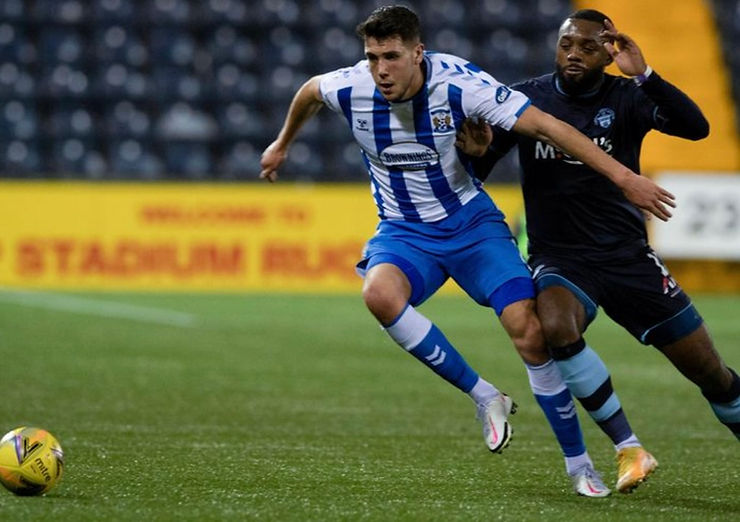
Due to his build, Sanders is adept at positioning his frame between man and ball to protect possession and then subsequently carry the ball. Simply put not many can dispossess him once he holds the ball, the opposition has to double up on him from multiple angles to win back the ball. Furthermore, his good level of agility combined with a composed poise enable him to move and adjust seamlessly with the ball at feet. As a result, Sanders is able to progress the ball proactively as shown below by his 1.82 progressive runs per 90. In possession, Sanders is adequate as when allowed time he can punch passes through the lines with accuracy. When pressed particularly on his weaker left-foot, Sanders’ touch becomes heavier and loses control of his passes. It must be noted that Kilmarnock as a top side had the most possession in the Scottish Championship so were typically licensed with more time and space on the ball. Moving into the Premiership, they won’t be afforded such factors, meaning Sanders’ fundamental possession-based skills will be more tested. Adopting a more open posture and increasing his speed of play on his left foot is required.
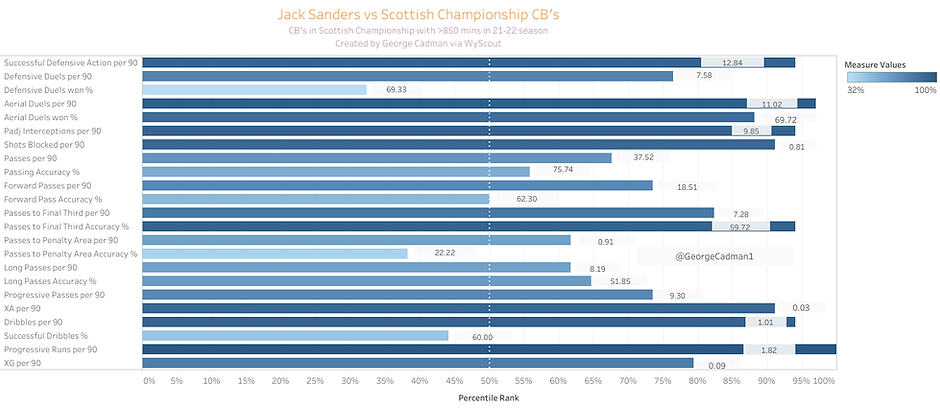
In defensive situations Sanders’ is a fierce competitor and frequent ball-winner. His size, dexterity and front-footed attitude allows him to usurp possession from the opposition with ease, block passing lanes and act as a menace in duels. Cutting in ahead of others to intercept a pass, using his long legs to wrap around and win the ball and powerfully jumping up to win headers are trademarks of his game. Overall, he’s a dynamic and dominant defender as depicted by his 12.84 successful defensive actions per 90.
It appears Sanders’ stellar season, although in limited minutes, has been overlooked by Killie’s front office. Sanders was ready to step into a more significant role especially after the departure of centre-back Euan Murray to League Two Hartlepool United, however the club have signed two centre-backs in the form of Scottish Under-21 international Lewis Mayo on loan from Rangers as well as Joe Wright. Sanders needed the 2021-22 season to get competitive minutes in a senior environment to test himself and he passed with flying colours. However, he needs more minutes and Kilmarnock does not seem to be the place for that to occur. Moving to Oxford as a back-up to start with seems prudent especially as the EFL calendar is so ruthless meaning rotation minutes will materialise. Sanders has the skillset and frame to translate to this role.
My Picks
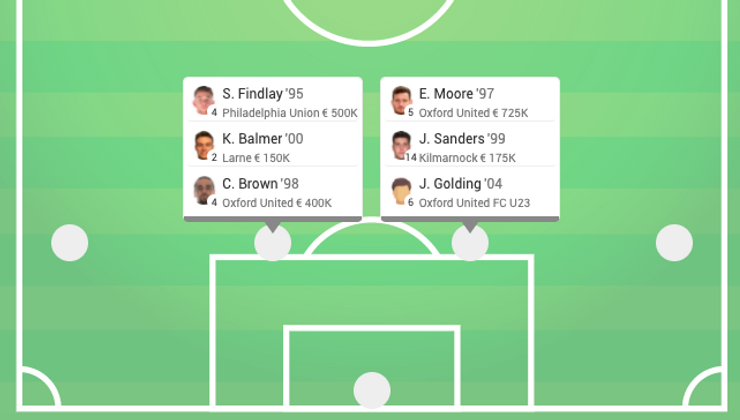
Replacing Luke McNally will be a difficult task considering the obscene quality he displayed in his sole season for Oxford United. Any of the three names within the shortlist are capable substitutes but likely won’t reach the same heights of quality and impact that McNally did, after all he was arguably the premier League One centre-back in 2021-22. In my opinion the best option is Kofi Balmer. The Northern Irishman would fit very well into Oxford’s possession heavy system. Capable of playing either at LCB or RCB, Balmer would offer an excellent option to partner Moore or Findlay. Oxford have history in securing talents from across the Irish Sea as exhibited by McNally, Gavin Whyte and Mark Sykes; and adding Balmer to that list for around £300,000 would be extremely good business. Even with the suggestion of signing Balmer, I believe the U’s should also sign Jack Sanders and slowly bed him into the side as a long-term replacement for Moore as his skillset is too hard to ignore especially at a likely fee of around £200,000. Having four centre-backs of the quality of Moore, Findlay, Balmer and Sanders would provide serviceable depth and allow tactical versatility if Robinson ever wanted to deploy a back three. Purchasing both Balmer and Sanders for around £500,000 would push Oxford into play-off contention and suitably replace McNally’s talent in respect to League One.
Thank you for reading,
George
All Statistics courtesy of WyScout.com unless stated and up to date as of 24.07.2022.
Please go follow my Twitter @GeorgeCadman1. Any feedback is greatly appreciated so feel free to DM me.
 The Mezzala In Midfield
Leave a comment